



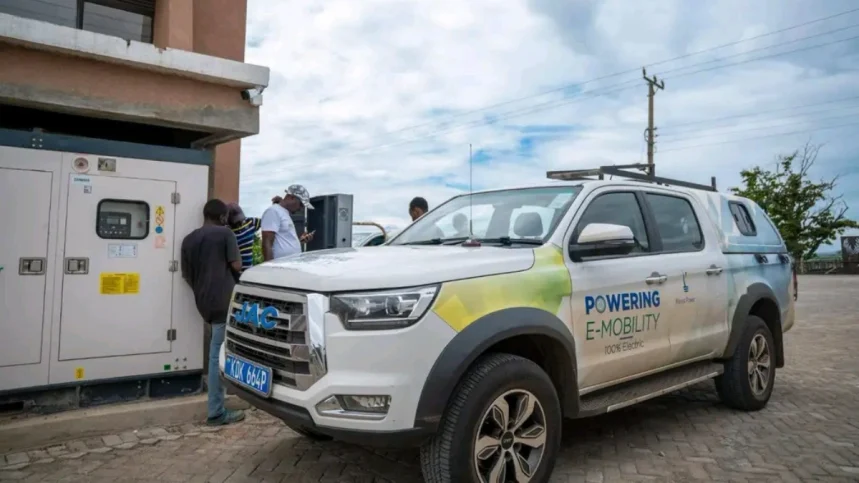

Kenya Power took the long journey from Nairobi to Maasai Mara via the Ngong to Suswa to Narok route with its electric vehicle fleet, aiming to test if EVs can be used on safari. The journey began yesterday, on Sunday, 22nd November 2026 to Tuesday, 24th November 2026, and stopped at several places to allow charging and refreshments.
It was associated with other EV teams like the Electric Mobility Association of Kenya (EMAK), African Horizons Safaris and Base2Charge.
They drove two JAC electric double-cab pickups that feature 65kWh batteries with about 300km of range on a full charge. The first take-off point was in Karen, where they charged the vehicles overnight for six hours and drove at an average speed of 60km/h.

The journey was more than a trip, and they demonstrated a real-world test of how electric mobility can support sustainable tourism in Kenya, while testing the JAC’s performance, energy efficiency, range across different terrains and charging stations.
After charging in Nairobi, they reached the second charging point at Sekenani Mall at about 2:30 pm. The battery status for one double cab was about 12% charge, which could provide about 35 km of range, while the other was at 20%, which provided about 65 km of range. The battery difference was due to the drivers’ behaviour. To get maximum efficiency, it is advised to get rid of excessive acceleration, mostly on steep sections.
More was awaiting them. They faced another challenge where the charger at the Sekenani facility failed. KPLC e-mobility engineers, led by Ian Kipruto and Maggy Gechanga, suggested using a mobile charger connected directly to the premises’ meter. They used 40 minutes of their time to identify the right connection point and set everything up, with one vehicle beginning to charge.
For the other vehicle, we couldn’t determine if it successfully charged, but Kenya Power opted to take half of the team to Entumoto Camp in Maasai Mara using other vehicles away from the ones being tested. The remaining distance was just 10 km away, and with 20% of the battery capacity remaining, they figured it could reach the destination.
Just 2 km into the remaining 10 km distance, the vehicle’s charge dropped to 15%, and the vehicle went into limp mode, refusing to climb an uphill section of the road. The reason behind the issue was due to the cells in the battery needing to balance, with some cells draining faster than others, which led to the vehicle not operating as intended on a charge below 20%. At that point, the vehicle was required to be brought to the garage later for further diagnostics, Ian stated. At 4:40 pm, they finally reached the camp.
For years, there has been a debate on whether electric vehicles can tackle long-distance journeys. Taking the EVs to one of Africa’s most iconic safari destinations provided real-time data on whether the vehicles can withstand the distance and what changes can be made so that they can build future electric vehicle mobility that operates smoothly with minimum downtime.